


5 October 2026
RESOURCES
Real-World Variability in PD Dialysate Order and Supply – Impact and Potential solutions
Background
Peritoneal dialysis is a resource intensive medical treatment requiring therapy adjustment based on fluid status, ultrafiltration requirements, residual kidney function, hospitalization, adherence, and glucose exposure needs. Current workflow requires patients/caregivers to take stock and order inventory weeks in advance, potentially limiting real-time personalization of therapy, and increasing care burden.
Methods
A retrospective observational study was done at an independent dialysis practice in California, US. Data of adult APD patients’ prescribed volume compared with supplier shipment records were evaluated. A period of 3 months’ data was presented at a patient level.
Results
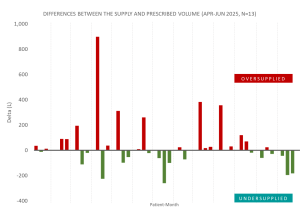
Thirteen PD patients contributed 39 patient-months of PD fluid utilization data between the months April – June 2025. Median prescribed dialysate volume was 310L (IQR: 235–372) per month versus median shipped volume of 328L (IQR: 231–390) per month. Mean oversupply volume was 36.7L (SD 199.5), ranging from−260.0L to +898L, resulting in an oversupply % ranging from −90% to +473%. Patterns of oversupply and undersupply frequently alternated across consecutive months, suggesting dynamic inventory correction cycles.
Conclusion
The results provide insight into potential downstream opportunity to improve coordination between prescribing, ordering, and delivery processes. Such operational enhancements may help facilitate resultant reduction in dialysate waste. Technologies enabling adaptive or on-demand dialysate generation may enable more responsive, patient-specific prescribing while reducing inventory instability and shipment mismatches.
Presented at ASN Kidney Week 2026, Denver, Colorado, United States, 21 – 25 October 2026.
Authors:
- Heberto Schramm, Desert Cities Dialysis, CA, United States
- Kriss Grande, Desert Cities Dialysis, CA, United States
- Priyanka Arya, Vivance, Singapore
- Sheena Gow, Vivance, Singapore
- Mandar Gori, Vivance, CA, United States
- Martin Schreiber, Cleveland Clinic, OH, United States; Vivance, CA, United States
- Arsh Jain, London Health Sciences Center, Ontario, Canada
- Prashanth Kumar, Desert Cities Dialysis, CA, United States