


22 September 2026
RESOURCES
Driving Green Dialysis: Environmental Value of Point-of-care PD Fluid Generation
Background
Conventional Peritoneal Dialysis (CPD) relies on large volumes of pre-packaged dialysis fluid leading to substantial plastic and packaging waste, transport emissions and dependency on centralized manufacturing, often concentrated in limited regions, making fluid supply vulnerable to events like Hurricane Helene.
Vivance’s Viva Komfort (Komfort) addresses these issues by generating dialysis fluid at point-of-care from tap water using advanced purification and mixing technologies. This decentralization reduces material use, strengthens supply resilience and lowers environmental impact.
Methods
Estimates for cardboard usage, plastic waste (kg) and treatment supplies weight (kg) were derived from industry benchmarks. Emissions were calculated using freight truck factor of 170 g CO₂/ton-mile (EPA 2023). Comparisons between CPD and Komfort were based on manufacturer specifications; and patient count was taken from 2024 USRDS report (Figure 1.8).
Results
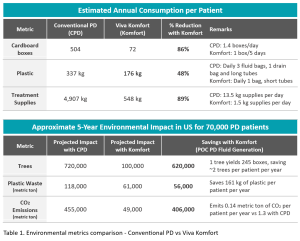
Compared with CPD, Komfort replaces 4 plastic bags with 1 concentrate bag per therapy, reducing storage needs by 89% and significantly easing the weight and volume that patients handle daily. This offers a more sustainable, space-efficient and patient-friendly approach to PD.
Over 5 years, Komfort could save ~620,000 trees, eliminate 57,000 metric ton of plastic waste and prevent 406,000 metric ton of CO₂ emissions in US alone (Table 1). Its lighter freight load also allows 1 truck to serve 10 patients, versus 1 under CPD.
Conclusion
The data highlights the significant environmental benefits enabled by Komfort’s technology, by reducing waste and carbon footprint. It also shows that such innovations can ease dependence on highly centralized manufacturing sites which are often vulnerable to disruption from natural disasters, while supporting the expected growth of PD population as care continues shifting toward home-based models. These findings position Komfort as a practical and scalable solution for greener, more resilient dialysis care.
Presented at ISPD Congress 2026, Cape Town, South Africa, 29 September – 03 October 2026. The abstract’s data was first presented at ASN Kidney Week 2025
Authors:
-
Akash Karopadi, Alira Health, MA, United States
-
Priyanka Arya, Vivance, Singapore
-
Jason Lim, Vivance, Singapore
-
Suresh Venkataraya, Vivance, Singapore
-
Mandar Gori, Vivance, CA, United States
-
Marjorie Foo, Singapore General Hospital, Singapore