


5 October 2026
RESOURCES
Microbiological and Endotoxin Evaluation of Point-of-care PD system for generating dialysis-grade water
Background
Point-of-care (POC) fluid generation, where a patient generates PD fluid at home is a novel therapy that has potential to reduce the carbon footprint of home dialysis and improve the uptake by reducing required storage space and handling of supplies. This study evaluated the ability of Viva Komfort, a POC PD system to generate purified dialysis-grade water suitable for therapy.
Methods
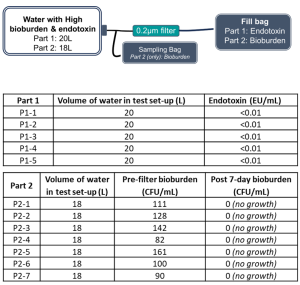
The system consists of multiple filters and a final positively charged, single-use 0.2μm in-line filter that converts tap water into 15L of dialysis-grade water per therapy. This sub-study aimed to stress-test the final 0.2μm in-line filter. A 2-part bench experimental study was designed to evaluate the purification performance of Viva Komfort. In Part 1, 20L of water with high endotoxin levels was passed through the 0.2μm filter and the water was tested for residual endotoxin. In Part 2, an additional sampling bag was placed pre-filter to collect bioburden samples. Quantified endotoxin concentration was analyzed using LAL assay and TSA was used to check bioburden after 7 days of incubation.
Results
A total of 12 tests were conducted (Part 1=5; Part 2=7). Tables show the endotoxin and bioburden results. In Part 1, endotoxin level in the tap water was 0.75EU/mL. The resultant endotoxin levels in all five tests were below detection limit (0.01EU/mL).
Conclusion
Despite being modular-level testing, these initial processes are required to ensure that dialysis-grade water can be produced safely in non-industrial environments. This study only stress-tested the last “line of defence” (0.2μm in-line filter) in the system, and it showed with a single filter, it was able to create sterile fluid. Future studies will incorporate the full water filtration system to ensure low levels of bioburden and endotoxin are maintained for an extended period of time.
Presented at ASN Kidney Week 2026, Denver, Colorado, United States, 21 – 25 October 2026.
Authors:
- Martin J. Schreiber, Cleveland Clinic, OH, United States; Vivance, CA, United States
- Prashanth Kumar, Desert Cities Dialysis, CA, United States
- Siti N. Jamaluddin, Vivance, Singapore
- Marcin Pawlak, Vivance, Singapore
- Sheena Gow, Vivance, Singapore
- Jason Lim, Vivance, Singapore
- Sridhar Chirumarry, Vivance, Singapore
- Sanjay Singh, Vivance, Singapore
- Mandar Gori, Vivance, CA, United States
- Arsh Jain, London Health Sciences Center, Ontario, Canada