


22 September 2026
RESOURCES
Proof of concept: Preclinical testing of point-of-care dialysate generation APD system, Viva Komfort, in a porcine model
Background
Viva Komfort (Komfort), an automated Peritoneal Dialysis (APD) system, is designed to generate dialysate from tap water, eliminating the need for bulk manufacturing, transportation and storage of PD fluids. The study aims to evaluate sterility, safety and feasibility of the Komfort point-of-care dialysate generation system in an ESKD porcine model.
Methods
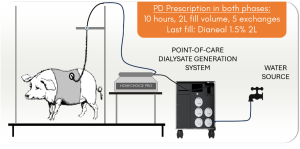
One male Sus scrofa pig (5/6 nephrectomy) underwent 28 days of APD therapy. During Baseline phase (Days 1–14), Dianeal™ Low Cal 1.5% dextrose dialysate was used. In the Komfort phase (Days 15–28), dialysate was prepared by Komfort system, which infused purified water into prefilled concentrate bags to make a solution comparable to Dianeal™ Low Cal 1.5%. Dialysis regimen (10 hours, 2L × 5 exchanges).
To assess device safety:
-
Purified water samples were tested for sterility and endotoxin load at the start of each phase;
-
Serum biochemistry and hematology were assessed every two days;
-
Dialysate total nucleated cell counts, drain cultures and turbidity were monitored daily. Turbidity was assessed by point-of-care turbidimeter using nephelometry.
Results
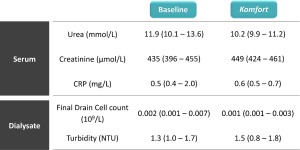
Purified water produced by Komfort system attained sterility with an endotoxin concentration of 0.01EU/mL at the start of Komfort phase, 0.00EU/mL at the end. No microbial growth was detected in dialysate cultures during the study or at one week post-study. Serum biochemical and haematology parameters, as well as dialysate characteristics, remained stable across.
Conclusion
The Komfort system successfully generated sterile, endotoxin-free dialysate from tap water that was well tolerated in a porcine PD model for 14 days. These results demonstrate the safety and feasibility of a point-of-care dialysate generation system. Extended preclinical and future human trials will be conducted. This technology has the potential to reduce supply-chain dependence and expand access to home dialysis worldwide.
Presented at ISPD Congress 2026, Cape Town, South Africa, 29 September – 03 October 2026. The abstract’s data was first presented at ASN Kidney Week 2025
Authors:
-
Arsh Jain, London Health Sciences Centre, Ontario, Canada
-
Prashanth Kumar, Desert Cities Dialysis, CA, United States
-
Marjorie Foo, Singapore General Hospital, Singapore
-
Htay Htay, Singapore General Hospital, Singapore
-
Sheena Gow, Vivance, Singapore
-
Jason Lim, Vivance, Singapore
-
Mandar Gori, Vivance, CA, United States
-
Sanjay Singh, Vivance, Singapore
-
Siti N. Huda, Vivance, Singapore
-
Martin Schreiber, Cleveland Clinic, OH, United States; Vivance, CA, United States